
Dear Diaspora: The Flag In Your Bio
Article 6 of the Dear Diaspora Series
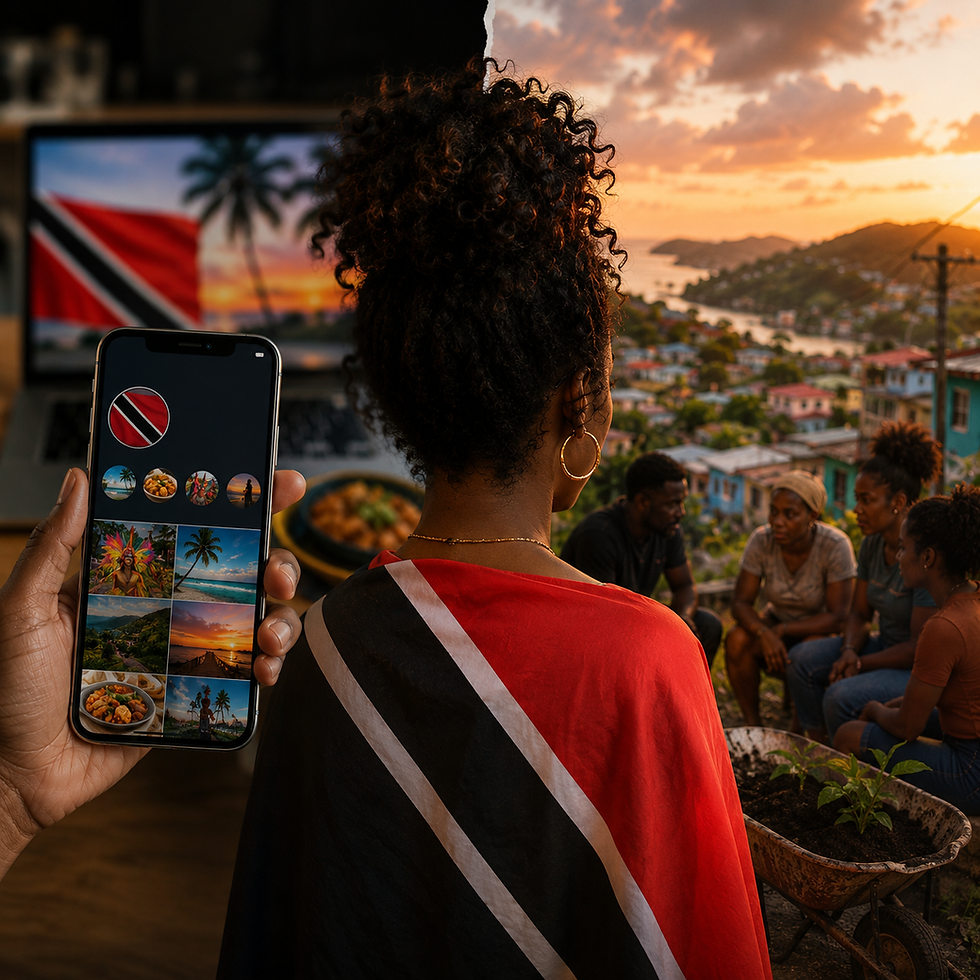
There is a particular kind of Caribbean person that appears online every Independence Day, Carnival season or whenever something major happens back home.
The flag appears — sometimes for the first time all year. The patriotic posts begin. A photo of doubles or a plate of curry crab and dumpling or a clip of soca from three Carnivals ago. "Trini to the bone." "Once a [insert nationality], always a [insert nationality]." "Home is always home."
And there is nothing inherently wrong with any of that. Pride in where you come from is a beautiful thing. It should exist. It should be visible.
The problem begins when identity becomes performance. When being Caribbean becomes something, we display rather than something we actively maintain. Because a flag in a bio and a connection to home are not necessarily the same thing. One is a symbol. The other is a relationship. And relationships require more than visibility. They require participation.
The Difference Between Remembering And Knowing
One of the realities of migration is that people often leave carrying a snapshot of home with them. The country they remember remains frozen in time: The neighbourhood, the school, the food, the music, the social norms, the political debates, the way people spoke and the way life felt.
But home does not remain frozen. It continues to evolve: New generations grow up, communities change, cultures shift, technology changes how people live, economies rise and fall, and political realities change.
The country you left twenty years ago may no longer be the country that exists today. And yet many diaspora conversations are built around memories rather than current realities. People speak confidently about places they no longer live in. They argue about issues they experience from a distance. They sometimes assume that being informed about a place is the same as living there. It isn't. Reading the news and living the news are not the same experience.
Knowing where you came from and knowing what home is today are not always the same thing.
There is a difference between having a perspective and having current lived experience. Both have value. The person who left may see things that those at home take for granted. The person who stayed may understand realities that cannot be fully appreciated from afar. Problems arise when either side assumes their perspective is the only one that matters.
Heritage Pride And Heritage Cosplay
This is where the conversation becomes uncomfortable.
There is a difference between celebrating your heritage and performing it. Heritage pride is rooted in genuine connection. It acknowledges history, values culture and supports communities. It remains curious about what is happening back home today.
Heritage cosplay is different. It reduces an entire culture to symbols, stereotypes and carefully selected moments. The accent comes out when it is convenient. And the flag appears when it is fashionable. The culture becomes something to wear rather than something to understand.
This is not unique to the Caribbean.
It happens in migrant communities all over the world. But it is worth examining. Because culture is deeper than food, festivals and nostalgia. It includes struggle, complexity, contradictions, growth, and the realities that people back home continue to navigate every day.
Why This Actually Matters
Here's why this isn't just semantics or gatekeeping.
When Caribbean culture becomes primarily something that gets performed for an outside audience, when Carnival becomes content, when patois becomes flavour, when "home" becomes a backdrop for a few photogenic days a year, something happens to how the culture itself gets perceived and treated.
It becomes a brand. An aesthetic. Something to be consumed, packaged, monetised by people with no stake in the actual place or its actual people.
And meanwhile, the people who live here, who deal with the cost of living, the politics, the infrastructure, the daily textures of life that never make it into a Carnival reel, watch their entire culture get reduced to its most photogenic two days. Watch people claim deep ownership over an identity while knowing almost nothing about its current reality. Watch "home" become someone else's costume.
That's not pride. That's extraction wearing pride's clothes.
"Trini To The Bone" — Says Who?
There's a particular phrase and every nationality has its version, that gets used as the ultimate declaration of identity. Trini to the bone. Bajan for life. Jamaican to the core.
And sometimes that phrase belongs to someone who has never lived here. Has visited twice. For Carnival. Stayed at a resort. Doesn't follow local news, couldn't name the current Prime Minister, doesn't know what's actually happening in the country beyond what occasionally goes viral.
Here's the honest question: what is that phrase actually describing?
Because heritage, real heritage, isn't diminished by distance. Someone born here, raised abroad from age two, who has never set foot back, absolutely still carries something real. Blood, family history, food cooked in their childhood home, stories passed down. That's not nothing. That matters.
But "to the bone" implies something more than ancestry. It implies immersion. It implies ongoing relationship. And when the word is being used to describe a connection that exists primarily through a flag emoji, a few photos a year, and a sense of cultural ownership over a place whose actual day-to-day reality is unknown — the phrase starts to feel less like an identity and more like a costume with very deep pockets.
Connection Requires More Than Nostalgia
Nostalgia is powerful.
It can preserve memories, maintain emotional ties and remind us where we came from. But nostalgia has limits. It tends to remember the best parts, edits out complexity, smooths over contradictions and sometimes it replaces curiosity. A person can spend years celebrating the country they remember while knowing very little about the country that exists today.
Authentic connection requires something more. It requires listening, learning, remaining engaged, being willing to accept that home changed while you were away and that the people who stayed may understand some realities differently than you do.
That does not invalidate your experience. It simply recognises that your experience is not the only one.
Maintaining connection from thousands of miles away is not easy. Life happens. Careers, children, financial pressures and immigration realities all compete for attention. Which is precisely why connection requires intentionality.
What Does Connection Actually Look Like?
None of this means heritage isn't real for people who didn't grow up here, or that connection requires living here permanently. That would contradict everything this series has been trying to say.
What it means is that connection has to be ongoing, not seasonal. It has to include the parts of home that aren't fun, photogenic or trending. It has to involve genuine curiosity about what's actually happening here — the good, the difficult, the boring, the complicated, not just the two days a year when home is having a moment online.
Migration does not erase heritage.
The question is what meaningful connection looks like after leaving. Real connection looks like following local news even when nothing dramatic is happening. It looks like understanding that the place has politics, problems, debates, and daily life that exists completely independent of whether the diaspora is paying attention. It looks like supporting initiatives back home, investing in communities rather than only criticising them, listening before speaking, and recognising that people who stayed and people who left each hold different pieces of the same story.
For many people in the diaspora, maintaining connection requires effort. They support family members, contribute to communities, follow local issues and look for ways to give back despite the distance. Authentic connection is not measured by where someone lives. It is measured by the willingness to remain engaged with the people and places that shaped them.
Because identity is not measured by geography alone, nor is it measured by a flag in a social media profile. It is measured by the relationship we maintain with the people, places and communities that helped shape us.
More Than A Symbol
There is nothing wrong with the flag. The flag matters. Symbols matter. They help us remember who we are but symbols are meant to point toward something deeper.
The flag is not the relationship. The flag represents the relationship.
The challenge for all of us, whether we stayed or left, is making sure the symbol does not become a substitute for the thing itself.
Because authentic connection is not something we display. It is something we nurture. And that requires far more than a flag in a bio.
One Last Thing
If you read this and felt a little defensive, sit with that for a second before reacting.
This isn't an attack on loving where you're from. It's an invitation to examine how that love shows up. Whether it's a relationship, ongoing, curious, sometimes uncomfortable, genuinely engaged or whether it's become something closer to a costume. Worn when convenient. Photogenic. Put away the rest of the year.
Home isn't a vibe. Home is a place where real people are living real lives, right now, today, whether or not anyone abroad happens to be looking.
Whisper to Your Heart
"Identity is not proven by how loudly we display it, but by how deeply we remain connected to the people and places that helped shape us."
– Nadia Renata | Audacious Evolution
Affirmation
"I honour my roots with humility, curiosity and respect. I remain open to learning, listening and deepening my connection to the communities that helped shape who I am."
– Nadia Renata | Audacious Evolution
Continue the Conversation
Previous in the Series: Dear Diaspora: We Educated You And Then We Watched You Leave — exploring brain drain, opportunity, loss and the complicated reality of watching generations leave in search of a better life.
Next in the Series: Dear Diaspora: Your Children Don't Know Us Anymore — on second and third generation diaspora families, cultural inheritance, identity, and what happens when the connection to home becomes a story rather than a lived experience.
This article is part of the Audacious Evolution Community series, which explores Caribbean culture, social norms and the unseen forces that shape behaviour and relationships. The goal is understanding, not blame, and creating space for more informed, compassionate conversations.
If this conversation resonated with you, you can explore more articles and reflections from Audacious Evolution across Body, Mind, Spirit and Community.
You can also connect with Audacious Evolution on Facebook, Instagram, TikTok, YouTube, BlueSky and X where these conversations continue beyond the website.


Comments